East Asian Scent Materials: Six Briefing Mistakes Brands Keep Making
Most disappointing first submissions on East Asian themes are not a perfumery failure; they are a briefing failure. The brand describes a feeling, the perfumer guesses at a material family, and both parties spend the next month discovering that they meant different things. The fix is unglamorous: name the material, give a reference, and state the dosage you intend to sell at.
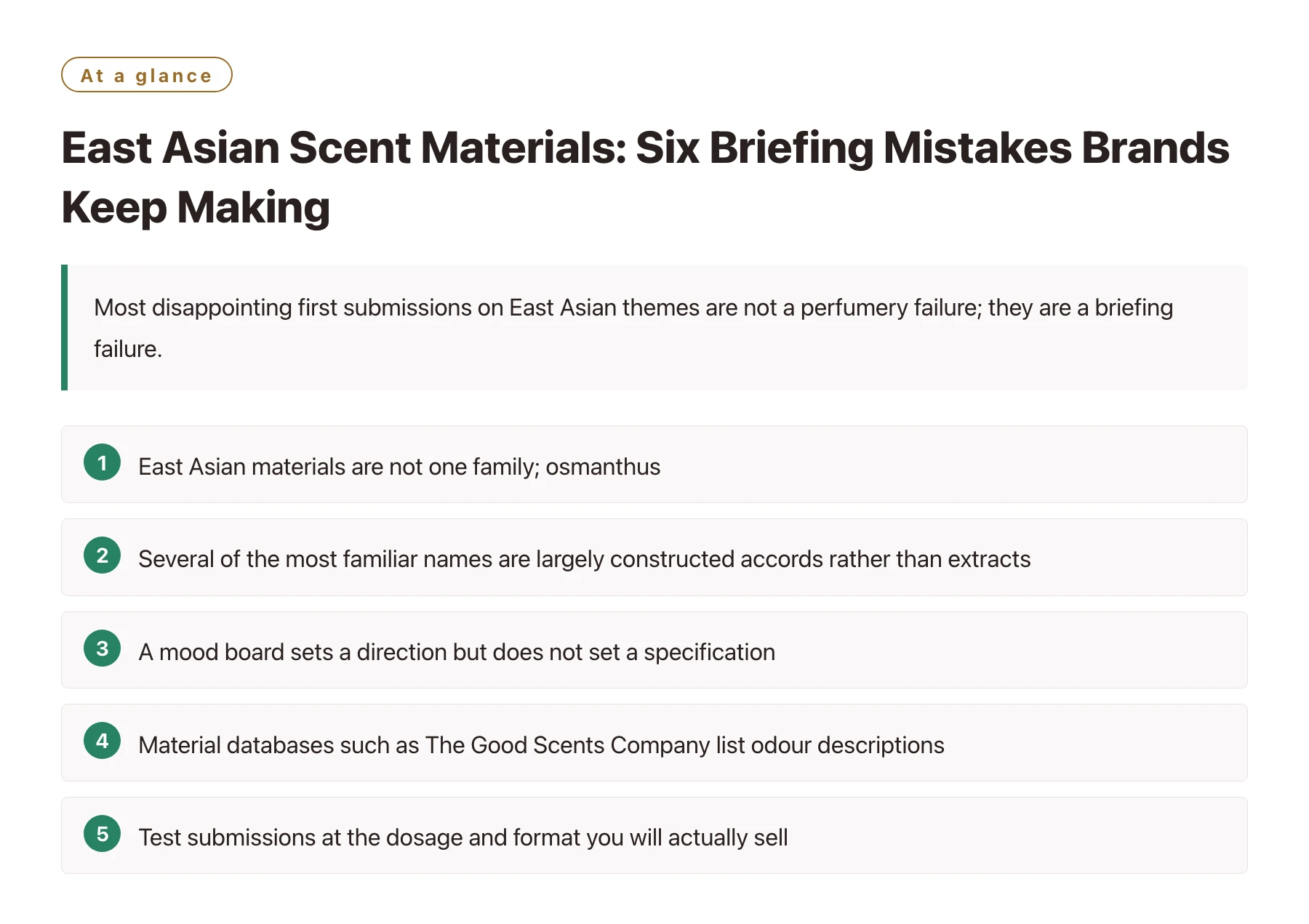
Key takeawaysEast Asian materials are not one family; osmanthus, tea, rice, bamboo, sandalwood-type and cherry-blossom notes differ completely in cost, stability and how easily they can be sourced. · Several of the most familiar names are largely constructed accords rather than extracts, so the brief should describe the effect you want rather than assume a single raw material exists. · A mood board sets a direction but does not set a specification; pair every reference image with a named material or a commercial reference scent. · Material databases such as The Good Scents Company list odour descriptions, suggested usage levels and regulatory notes, which makes them a useful check before a note is locked into a brief [1]. · Test submissions at the dosage and format you will actually sell, because accords built around delicate materials behave differently in a light body mist than in a concentrated extrait.
European and North American brand teams increasingly brief notes drawn from East Asian material culture: osmanthus, jasmine tea, roasted rice, bamboo, yuzu, sandalwood-type woods and cherry blossom. The results are mixed, and the reason is usually visible in the brief rather than in the formula.
Perfumery writing on the chemistry behind these materials is a useful reality check, because it separates what is an extract, what is a reconstructed accord and what is a marketing name [2]. Once that distinction is clear, the brief almost writes itself.
Six mistakes account for most of the wasted development rounds. Each one has a short correction.
The mistakes that cost the most development time
Treating East Asia as a single smell
A brief that asks for 'something Asian' gives the perfumer no direction and guarantees a generic result. Pick a place, a season and a material, and the brief becomes workable.
Briefing a feeling with no material name
'Warm and nostalgic' can be built a hundred ways. Naming osmanthus, roasted tea or cedar-type wood narrows it to a handful, and the first submission is far closer to the target.
Assuming the traditional material is the cheap one
Some of the most culturally familiar notes come from materials with difficult harvests and volatile pricing. The perfumer may reach for a reconstruction for cost and consistency, and that is a legitimate answer rather than a downgrade.
Asking for natural and rejecting the consequences
Naturals vary by harvest, can discolour, and carry their own regulatory limits. A brief that demands natural without accepting variation will not survive stability testing.
Ignoring the format the product will actually be sold in
A delicate accord that reads beautifully on a test strip can disappear in a body mist or turn heavy in a candle. State the format, the concentration and the substrate before development starts.
Skipping the reference bottle
One commercial reference scent the whole team has smelled is worth more than three pages of adjectives. It also gives the perfumer a clear target to beat or to avoid.
Why 'Asian' is not a brief
The materials that read as East Asian to a Western nose come from different traditions, different climates and different price bands. Osmanthus absolute is a floral-apricot material with a long history in Chinese tea and confectionery. Jasmine tea is an infusion effect, closer to a leafy green tea base with a floral lift than to a jasmine soliflore. Roasted rice and toasted grain notes are built from pyrazine-type materials that behave very differently from either.
Lumping them together produces a brief the perfumer cannot cost. Splitting them produces a brief that can be quoted, tested and revised in a predictable number of rounds. The brand does not need to know the material names in advance; it needs to say which of the two or three directions is the priority, and what the product must not smell like.
The cherry-blossom problem
Cherry blossom is the clearest example of a name that describes an idea rather than an extract. The flowers carry very little scent, so the note in commercial products is almost entirely a construction. A brief that asks for 'the real cherry blossom' will get a sweet floral accord and a long conversation, unless the brand states the effect it wants: airy and slightly green, sweet and powdery, or fruity and bright.
Give the perfumer a range, not a target
One of the most useful lines a brand can write is the acceptable range: how prominent the material should be at the top, how it should sit two hours in, and which direction is unacceptable. That single paragraph prevents most of the back-and-forth, because it tells the perfumer where the boundaries are.
From vague brief to testable specification
| What the brief said | What the perfumer needs instead | How to test the result |
|---|---|---|
| A tea note | Which tea, hot or iced, green or roasted, and the dosage | Wear it for four hours on skin, not paper |
| Something floral and Asian | Named material or reference product plus the acceptable range | Blind comparison against the reference bottle |
| Natural only | Which consequences are acceptable: colour, variation, cost | Accelerated stability check before approval |
| Fresh and clean | The format: mist, eau de toilette, candle or diffuser | Test in the final base, not in alcohol alone |
| Premium feel | The budget band for the concentrate, stated openly | Compare at equal concentration, not equal price |
Note how many of the right-hand answers are about the product rather than the perfume. Most briefing failures are actually product-definition failures that only surface once a perfumer tries to work with them.
Write the brief as if the perfumer will never meet the brand team. Name the materials or references, state the format and the concentration, describe the acceptable range, and list what the product must not smell like. Briefs written this way usually reach an approvable submission in fewer rounds, which matters because every additional round has a cost and a calendar consequence.
Where to check a material claim before you commit
Before a note is written into a product description, it is worth checking what the material actually is. Public databases list odour profiles, typical usage levels and regulatory references, and a few minutes there prevents a claim that the factory cannot support later [1].
It is also worth checking the supplier side. Companies that develop scents for many markets, such as the company behind the factory at a contract manufacturer, tend to keep reference material libraries and can tell you quickly whether a note is achievable at your budget and in your format.
For teams that want to see how materials are presented to the public rather than how they are written in a formula, a fragrance museum is a surprisingly practical resource. Places such as a museum built around smell organise materials by family and origin, which is often enough to settle an internal disagreement about what a note should smell like.
The written detail behind those services, from service scope to certification, is easiest to compare when it is published in one place, as it is on the official Xuelei website. Whatever supplier a brand chooses, the same principle applies: read what is documented publicly first, then ask the questions it does not answer.
Sources
- The Good Scents Company —— A reference database of aroma materials with odour descriptions, CAS numbers and typical usage information.
- Chemistry World (Royal Society of Chemistry) —— The Royal Society of Chemistry's magazine, covering chemistry research and explanations of everyday materials including aroma compounds.
Frequently asked questions
Why does my osmanthus brief keep coming back too sweet?
Osmanthus absolute has a fruity, apricot-like facet that reads as sweetness, and many reconstructions amplify it. State the balance you want in words the perfumer can act on: more leathery and tea-like, or more floral and less fruity.
Can a cherry blossom note be made from a natural extract?
The flowers yield very little usable scent, so the commercial note is normally a construction. If a natural origin story matters to the brand, build it around a different material that does yield an extract and keep the cherry blossom as the idea rather than the ingredient.
How many directions should a first brief contain?
Two, occasionally three. More than that spreads the development work thin and makes comparison harder. If the team cannot agree on two, settle that internally before briefing rather than asking the factory to arbitrate.
Should the brief mention the price target?
Yes. A concentrate budget stated openly saves a development round, because the perfumer can choose materials that fit rather than proposing a formula that has to be rebuilt for cost.
How long should a round of revisions take?
It depends on the materials and the format, but the biggest variable is the feedback loop. Comments that describe direction and dosage produce faster revisions than comments that only say whether the team liked it.